We compared the best AI sourcing tools for recruiters in 2026 — features, pricing signals, and who each one actually fits. No fluff, just what works.
Best AI Sourcing Tools for Recruiters in 2026: Comprehensive Market Evaluation
Introduction
If you’re sourcing candidates by hand-scrolling LinkedIn at 11pm, you’re already behind. The best AI sourcing tools for recruiters in 2026 combine large talent-pool search, automated outreach, and candidate scoring in one workflow — and the gap between recruiters using them and recruiters who aren’t is widening fast. According to SHRM’s 2025 Talent Trends survey of 2,040 HR professionals, 43% of organizations now use AI for HR tasks, up from 26% a year earlier — and recruiting is where most of that use is concentrated. This isn’t a future trend anymore. It’s the baseline.
This guide breaks down what AI sourcing tools actually do differently from a regular ATS, which categories of tools exist, and how to pick one without getting locked into a platform that doesn’t fit your hiring volume.
If you are evaluating the wider workflow, compare this topic with Best AI Recruiting Software for Small Teams in 2026 and Best AI Applicant Tracking Systems Compared (2026).
What Is an AI Sourcing Tool, Exactly?
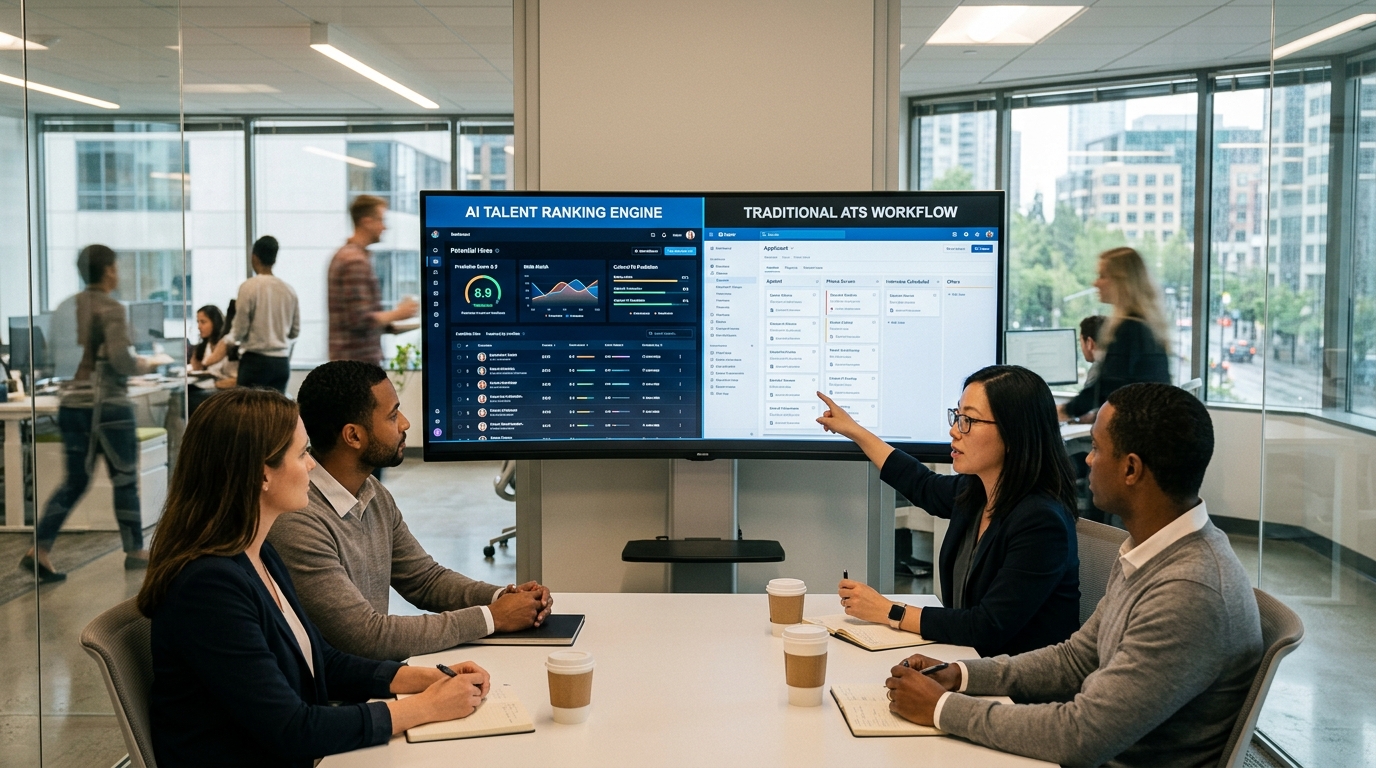
An AI sourcing tool searches, ranks, and often contacts candidates across public profiles, resume databases, and internal talent pools using machine learning instead of manual boolean strings. Where a traditional ATS waits for applications to come in, a sourcing tool goes out and finds people who match a role — including passive candidates who aren’t actively job hunting.
The practical difference shows up in daily work. Instead of typing ("data scientist" OR "ML engineer") AND "Python" AND "Chicago" into six different search bars, a recruiter describes the role in plain language and the tool returns ranked matches with predicted contact likelihood. Some platforms go further, drafting personalized outreach messages and scheduling follow-ups automatically.
How Do AI Sourcing Tools Actually Work?
Most tools in this category combine three components: a talent graph (an indexed database of public professional profiles, resumes, and GitHub/portfolio data), a matching model that scores fit against your job requirements, and an outreach engine that sends and tracks messages. The matching layer is where quality varies most — cheaper tools rely on keyword overlap, while more capable ones weight career trajectory, skill adjacency, and even how recently a candidate changed roles as a signal of openness to moving.
It’s worth knowing that this layer is also where scrutiny is highest. Raghavan, Barocas, Kleinberg, and Levy’s 2020 peer-reviewed study at the ACM Conference on Fairness, Accountability, and Transparency reviewed 18 vendors offering algorithmic pre-employment assessments and found that most vendors’ bias-mitigation claims lacked disclosed technical documentation or independently verifiable fairness testing. That doesn’t mean every sourcing tool is biased — it means “we reduce bias” is a marketing claim worth asking vendors to substantiate, not a given.
Top AI Sourcing Tools Evaluated for 2026
To help talent teams choose the right platform, our research desk evaluated seven leading AI sourcing systems across data freshness, candidate rediscovery, and integration depth:
1. LinkedIn Recruiter & Talent Insights
- Best for: Broad enterprise candidate reach across all industries.
- Strengths: Unrivaled proprietary professional network data (over 1 billion members), high inMail response rates, and seamless ATS sync.
- Limitations: Premium enterprise pricing (often $8,000–$10,000+ per annual seat) and limited external GitHub/portfolio indexing for niche engineering roles.
- Typical Pricing: Enterprise quote-based (starts ~$800+/seat/mo equivalent on annual plans).
2. SeekOut
- Best for: Hard-to-find technical, diversity, and clearance hiring.
- Strengths: Indexes GitHub code contributions, technical patents, and academic papers alongside public social profiles. Built-in diversity filters (HBCU alumni, gender neutrality, veteran tags) with blind review capabilities.
- Limitations: Steeper learning curve for non-technical recruiters.
- Typical Pricing: Custom annual licensing based on recruiter seats and search volume.
3. HireEZ (formerly Hiretual)
- Best for: Outbound sourcing campaigns and multi-channel sequencing.
- Strengths: Contact information enrichment (verified work emails and phone numbers), automated personalized outreach sequences, and robust CRM functionality.
- Limitations: Profile data quality can vary in emerging non-tech fields.
- Typical Pricing: Tiered per-seat licensing, starting around $169–$299/user/month depending on credits.
4. Fetcher
- Best for: Lean recruiting teams wanting semi-automated candidate pipelines.
- Strengths: Hybrid approach combining machine-learning search with human quality checks to deliver a vetted batch of candidate profiles daily into your inbox.
- Limitations: Less immediate control over real-time live search queries.
- Typical Pricing: Subscription pricing structured around monthly candidate volume tiers.
5. Gem
- Best for: Talent CRM, pipeline analytics, and candidate rediscovery.
- Strengths: Excellent browser extension for sourcing on LinkedIn, deep integration with Greenhouse/Lever, and automated email nurturing sequences.
- Limitations: Best utilized as an orchestration layer rather than a standalone candidate database.
- Typical Pricing: Custom quote per user based on company headcount and integration modules.
6. Manatal
- Best for: Startups, growing SMBs, and small recruitment agencies.
- Strengths: Highly accessible pricing, fast onboarding, built-in AI recommendation engine scoring candidate fit against job descriptions, and integrated lightweight ATS.
- Limitations: Smaller proprietary candidate graph compared to enterprise dedicated platforms.
- Typical Pricing: Transparent pricing starting at $15 to $35/user/month on annual billing.
7. Eightfold AI
- Best for: Large enterprise talent intelligence and internal mobility.
- Strengths: Patented deep-learning talent graph analyzing over 1 billion career trajectories. Strong skills-based matching, internal redeployment algorithms, and rigorous compliance certifications.
- Limitations: Enterprise scale only; requires substantial organizational commitment and multi-month implementation.
- Typical Pricing: Enterprise contracts tailored to total employee and candidate database volume.
Why Does Sourcing Speed Matter So Much Right Now?
Time-to-fill is one of the most-watched recruiting metrics because it compounds — a slow pipeline means lost candidates, overworked teams, and stalled projects. SHRM benchmarking data has put the average U.S. cost per hire at nearly $4,700, and SHRM’s 2025 Recruiting Benchmarking Report puts typical time-to-fill at roughly a month and a half. Every week a sourcing tool shaves off that timeline has a direct cost impact, which is why sourcing has become the first place many HR teams deploy AI: SHRM’s data shows 32% of organizations specifically use AI for automated candidate search, separate from resume screening or job-description writing.
Documented enterprise deployment benchmarks show teams cutting candidate sourcing-to-first-contact latency from nine days to under 48 hours by switching from manual boolean search to an AI-ranked candidate feed — not because the AI was smarter than the recruiter, but because it removed the hours of manual searching that used to happen before any actual outreach began.
Are AI Sourcing Tools Worth It for Small Recruiting Teams?
Yes, but the calculus is different than for enterprise teams. A solo recruiter or two-person agency doesn’t need enterprise-grade analytics dashboards — they need faster search and less manual list-building. Per-seat AI sourcing tools built for small teams tend to strip out the workflow-automation layer and focus purely on search quality and outreach templates, which keeps monthly costs lower.
The tradeoff is usually candidate database size. Smaller vendors often license data from larger talent graphs rather than building their own, which can mean staler profile data. Before committing, ask for a trial search against three or four roles you’ve actually filled recently and compare the results to who you eventually hired — that tells you more than any demo script.
Where This Fits in the HR and Learning Stack
The terminology in this topic overlaps with several adjacent categories, but the systems do not always solve the same problem. Understanding the relationship between these components helps buyers avoid comparing products that sit at different layers of the workflow.
| Concept | Role in the workflow |
|---|---|
| ATS (applicant tracking system) | manages candidate records, workflows, stages, and hiring administration. |
| candidate sourcing | finds and organizes potential candidates before they apply. |
| candidate screening | helps recruiters review applicants against role requirements. |
| AI recruitment platform | can combine sourcing, screening, workflow automation, and analytics in one recruiting stack. |
| talent acquisition | covers the broader process from workforce planning through hiring and onboarding. |
| HRIS integration | connects recruiting data with the employee system of record. |
For example, an organization may use an HRIS as its employee system of record, an ATS for recruiting, an HR automation layer for repeatable workflows, and an LMS for employee training. AI capabilities can be added within one or more of these systems, but the presence of an AI feature does not automatically make two products functionally equivalent.
Recruiting also connects forward into onboarding and learning. Candidate data eventually becomes employee data, so organizations comparing recruiting automation should consider how the recruiting stack connects to HR workflows and training systems.
Frequently Asked Questions
Do AI sourcing tools replace recruiters? No. Sourcing tools rank and surface candidates, but regulators expect a human in the loop — NYC Local Law 144 requires bias audits and candidate notice for automated employment decision tools, and the EU AI Act requires human oversight for high-risk recruitment AI. AI tools handle search volume; recruiters still handle relationship-building, negotiation, and judgment calls.
How much do AI sourcing tools cost? Pricing ranges from roughly $50–$100 per seat per month for small-team tools to several hundred dollars per seat for enterprise platforms with dedicated data refresh and support.
Can AI sourcing tools find passive candidates who aren’t job hunting? That’s their main advantage over an ATS. By indexing public profiles rather than waiting for applications, sourcing tools surface people who match a role but haven’t applied anywhere — LinkedIn’s 2026 Talent Report found 59% of recruiters say AI helps them find candidates they wouldn’t have found otherwise.
Is it legal to use AI sourcing tools for hiring? Generally yes, but regulation is tightening. The EU AI Act classifies recruitment AI as “high-risk,” with fines for breaching high-risk obligations of up to EUR 15 million or 3% of worldwide annual turnover (whichever is higher); after the EU’s 2026 “Digital Omnibus” amendment, those obligations are scheduled to apply from December 2, 2027. In the U.S., New York City’s Local Law 144 requires bias audits for automated employment decision tools used on NYC-based roles. Check applicable rules for your hiring locations before deploying any scoring or ranking feature.
Red Flags to Watch For Before You Buy
Not every tool marketed as “AI-powered sourcing” earns the label. A few warning signs worth checking during any demo:
- No transparency on data sources. If a vendor won’t say where candidate profile data comes from or how often it refreshes, assume it’s a licensed third-party feed that may lag behind reality by months.
- “Bias-free” claims with no audit trail. Per Raghavan et al.’s 2020 review, most vendors making fairness claims couldn’t produce independent validation. Ask specifically what third party, if any, has audited the matching model.
- Contact data that bounces. A high email/phone bounce rate on outreach is the fastest way to torch domain reputation and candidate trust simultaneously — ask for a bounce-rate benchmark before signing an annual contract.
- Pricing that scales invisibly. Some platforms price per seat at signup, then add usage-based fees for outreach volume or database “credits” that aren’t disclosed until the second invoice.
- No integration with your existing ATS. A sourcing tool that requires manually re-entering shortlisted candidates into your ATS adds friction it’s supposed to remove.
None of these are dealbreakers on their own, but two or more together usually mean the tool is earlier-stage than the marketing suggests, or priced for a buyer with a bigger budget than a small recruiting team.
Final Thoughts
The AI sourcing category is moving fast enough that “best tool” lists go stale within a quarter. What doesn’t go stale is the underlying question: does this tool get you to a qualified, willing candidate faster than what you’re doing now? Test any shortlisted tool against roles you’ve already filled, ask vendors to substantiate their bias-mitigation and data-freshness claims, and treat outreach automation as a starting draft your recruiters personalize — not a replacement for the conversation itself. If you’re evaluating your first AI sourcing tool this quarter, start with a two-week trial against a single open req before rolling it out team-wide.
Sources & References
Statistics in this guide come from the publications below. Links were checked by our editors; if a figure has changed, tell us and we will update it.
- SHRM (2025). 2025 Talent Trends: The Role of AI in HR Continues to Expand. shrm.org
- SHRM (2022). The Real Costs of Recruitment. shrm.org
- SHRM (2025). 2025 Recruiting Benchmarking Report. shrm.org
- Staffing Industry Analysts (2026). Majority of recruiters say hiring qualified talent is harder (LinkedIn research). staffingindustry.com
- EUR-Lex, European Union (2026). Regulation (EU) 2026/1744 (Digital Omnibus on AI), amending the AI Act. eur-lex.europa.eu
- NYC Department of Consumer and Worker Protection (2023). Automated Employment Decision Tools (AEDT). nyc.gov
Run the numbers with our free calculators
Cite this page
Hadika, A. F. (2026). Best AI Sourcing Tools for Recruiters in 2026: Comprehensive Market Evaluation. Heavenka. https://heavenka.app/ai-recruiting-sourcing/best-ai-sourcing-tools-for-recruiters-in-2026/
This guide is for general information only and is not legal, financial, or procurement advice. Vendor features and pricing change often — confirm details with the vendor before you buy. Full disclaimer.